 Halden
UK cosmetics law in 2026: the two SIs that change your formulas
Two statutory instruments made in 2026 amend the GB version of the Cosmetics Regulation (EC) 1223/2009. Both were made under Articles 31 and 32 of that Regulation, both extend to England and Wales and Scotland, and both have dates that are already live or close. If you sell into Great Britain, these are the ones to check your formulas against.
We have read both instruments in full on legislation.gov.uk. This is what they do.
SI 2026/23: a UV filter ban, 16 CMR bans and a new formaldehyde warning
Full title: The Cosmetic Products Regulation (EC) No
1223/2009 (Restriction of Chemical Substances) (Amendment and
Transitional Provisions) Regulations 2026
Made: 12 January 2026
Laid before Parliament: 15 January 2026
In force: 15 July 2026, except the CMR bans, which came
into force on 15 August 2026
4-MBC is now prohibited
3-(4’-methylbenzylidene)-camphor (4-MBC, also listed as Enzacamene) is added to Annex 2, the list of prohibited substances, as entry 1744. Its entry in Annex 6, the list of permitted UV filters (reference number 18), is removed.
The formaldehyde warning has changed
Paragraph 2 of the preamble to Annex 5 covers products containing preservatives that release formaldehyde. The SI makes two changes. The warning wording changes from “contains formaldehyde” to “releases formaldehyde”. The threshold falls from 0.05% to 0.001% of formaldehyde in the finished product.
That second change is the one most likely to catch brands out. A product that did not need the warning before 15 July 2026 may need it now.
16 CMR substances added to Annex 2
From 15 August 2026, entries 1745 to 1760 are prohibited. These are substances classified as carcinogenic, mutagenic or toxic for reproduction (CMR) in category 1B or 2. They include TPO (diphenyl(2,4,6-trimethylbenzoyl)phosphine oxide, CAS 75980-60-8), tetrabromobisphenol-A, 4-methylimidazole, acetone oxime, dibutyltin maleate and dibutyltin oxide, trimethyl borate, S-metolachlor and multi-walled carbon tubes (an entry that includes multi-walled carbon nanotubes).
Sell-through periods
- 4-MBC: a product placed on the market before 15 July 2026 may continue to be made available until the end of 14 January 2027 if it both contains 4-MBC and is labelled in line with paragraph 2 of the Annex 5 preamble as it stood before 15 July 2026. Regulation 3 sets no separate sell-through period for the formaldehyde change on its own, so a product without 4-MBC does not fall within this period.
- The 16 CMR substances: a product placed on the market before 15 August 2026 may continue to be made available until the end of 14 February 2027.
SI 2026/109: 13 more CMR bans and a hexyl salicylate cap
Full title: The Cosmetic Products Regulation (EC) No
1223/2009 (Restriction of Chemical Substances) (Amendment and
Transitional Provisions) (No. 2) Regulations 2026
Made: 4 February 2026
Laid before Parliament: 9 February 2026
In force: 15 August 2026, except the new Annex 2 bans,
which come into force on 23 March 2027
Hexyl salicylate moves into Annex 3
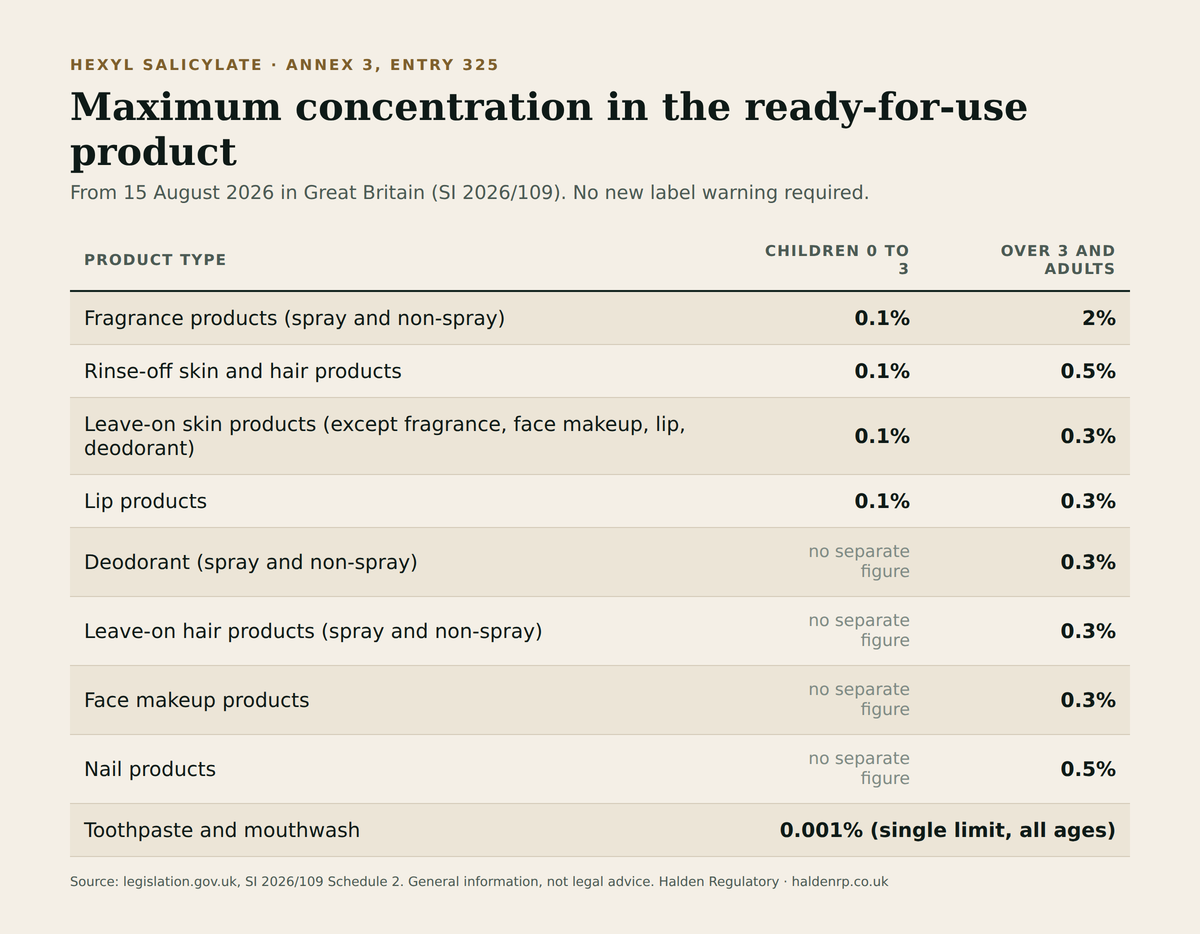
Hexyl salicylate (hexyl 2-hydroxybenzoate, CAS 6259-76-3) is a common fragrance ingredient. It is classified as a CMR category 2 substance. The instrument records the Secretary of State’s view that there is sufficient scientific evidence that it is safe for use in cosmetic products, and the explanatory note says the limits follow advice from the Scientific Advisory Group on Chemical Safety of Non-Food and Non-Medicinal Consumer Products. From 15 August 2026 it is entry 325 in Annex 3, with these maximum concentrations in the ready-for-use product:
| Product type | Products for children 0 to 3 years | Products for children over 3 and adults |
|---|---|---|
| Fragrance products (spray and non-spray) | 0.1% | 2% |
| Rinse-off skin and hair products | 0.1% | 0.5% |
| Leave-on skin products (not fragrance, face makeup, lip or deodorant) | 0.1% | 0.3% |
| Lip products | 0.1% | 0.3% |
| Deodorants (spray and non-spray) | no separate figure | 0.3% |
| Leave-on hair products (spray and non-spray) | no separate figure | 0.3% |
| Face makeup products | no separate figure | 0.3% |
| Toothpaste and mouthwash | 0.001% (no age split) | 0.001% (no age split) |
| Nail products | no separate figure | 0.5% |
For toothpaste and mouthwash the entry gives a single 0.001% limit with no age group attached. For deodorants, leave-on hair, face makeup and nail products it gives a figure only for children above 3 years and adults. The entry sets product types and concentration limits only. It adds no new label warning.
Sell-through: a product containing hexyl salicylate that was placed on the market before 15 August 2026 may continue to be made available until the end of 14 February 2027.
13 more CMR substances in Annex 2, from 23 March 2027
Entries 1761 to 1773 are added to Annex 2. They include ozone, dinitrogen oxide, pyraclostrobin, fenpropidin, N,N’-methylenediacrylamide, 2-phenylpropene (α-methylstyrene), and silver in two forms: nano silver (particle diameter above 1 nm and up to 100 nm) and massive silver (particle diameter of 1 mm or more).
Sell-through: a product containing one of these substances that was placed on the market before 23 March 2027 may continue to be made available until the end of 22 September 2027.
The dates in one place
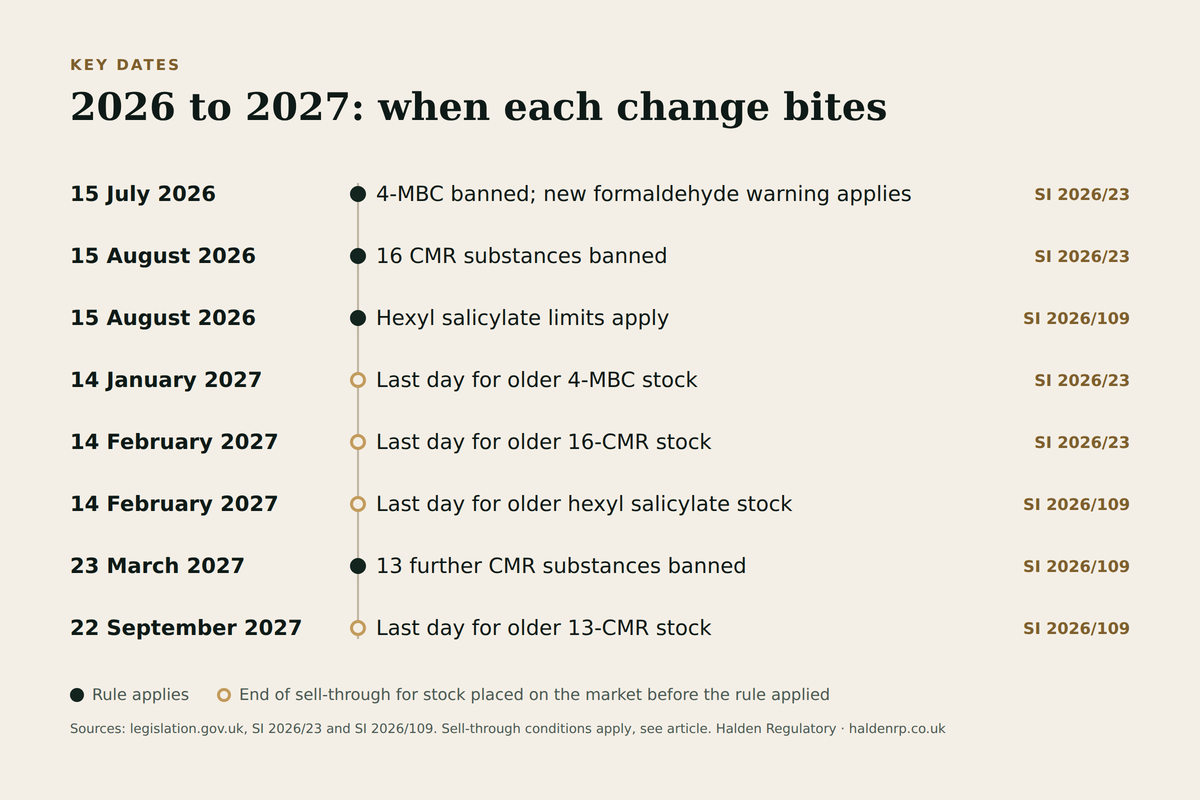
| Date | What happens |
|---|---|
| 15 July 2026 | 4-MBC banned; formaldehyde warning becomes “releases formaldehyde” above 0.001% |
| 15 August 2026 | 16 CMR substances banned (SI 2026/23); hexyl salicylate limits apply (SI 2026/109) |
| 14 January 2027 | Last day for older stock containing 4-MBC (old formaldehyde labelling allowed on that stock) |
| 14 February 2027 | Last day for older stock containing the 16 CMR substances or hexyl salicylate |
| 23 March 2027 | 13 further CMR substances banned (SI 2026/109) |
| 22 September 2027 | Last day for older stock containing those 13 substances |
What this means for your brand
- Ask your fragrance supplier for the hexyl salicylate level in your compound, then work out the level in the finished product.
- If any product uses a formaldehyde-releasing preservative, ask for the concentration of formaldehyde in the finished product and check it against 0.001%. Unless the product also contains 4-MBC, the sell-through period in SI 2026/23 does not cover it.
- Check your full formulas and raw material specifications, not only the INCI list on the pack, against the 29 CMR substances added to Annex 2 (entries 1745 to 1773, of which entries 1761 to 1773 apply from 23 March 2027).
- If a formula changes, the safety report, the Product Information File and the SCPN notification are likely to need reviewing. Check with your Responsible Person or safety assessor.
- Watch the sell-through dates. They are about when a product was placed on the market, so stock planning matters.
If you would like a second pair of eyes, our free label check is open, or we can quote for UK Responsible Person cover.
Sources
- SI 2026/23, as made: https://www.legislation.gov.uk/uksi/2026/23/made
- SI 2026/23, Schedule: https://www.legislation.gov.uk/uksi/2026/23/schedule/made
- SI 2026/23, regulation 2: https://www.legislation.gov.uk/uksi/2026/23/regulation/2/made
- SI 2026/23, regulation 3 (transitional provisions): https://www.legislation.gov.uk/uksi/2026/23/regulation/3/made
- SI 2026/109, as made: https://www.legislation.gov.uk/uksi/2026/109/made
- SI 2026/109, Schedule 1 (Annex 2 entries 1761 to 1773): https://www.legislation.gov.uk/uksi/2026/109/schedule/1/made
- SI 2026/109, Schedule 2 (Annex 3 entry 325, hexyl salicylate): https://www.legislation.gov.uk/uksi/2026/109/schedule/2
- SI 2026/109, regulation 3 (transitional provisions): https://www.legislation.gov.uk/uksi/2026/109/regulation/3/made
- Regulation (EC) 1223/2009 as it applies in GB, Annex V: https://www.legislation.gov.uk/eur/2009/1223/annex/V
This post is general information, not legal advice. It reflects the instruments as made, checked on legislation.gov.uk on 11 October 2026.